Strategy and content · Tip 02 / 12
Reels Hooks: How to Stop Viewers in the First Second
A good Reels hook is the moment the thumb stops scrolling. We'll show you how to plan the first second of your Reel with visuals, text and sound, so viewers want to stay until the very end.
- Instagram Reels hooks
- how to stop the scroll
- first second of a Reel
- TikTok hooks
- audience retention
- Reels ideas
01Why your Reels hook matters more than the rest of the video
A Reels hook is the first second – sometimes two – in which the viewer decides whether to stay or keep scrolling. On Instagram and TikTok the feed is endless, and every Reel competes with thousands of others. You can have great editing, beautiful lighting and valuable content, but if the opening doesn't grab attention, hardly anyone will see the rest.
Platforms take into account how long people watch your videos and whether they watch them to the end. A Reel that holds viewers has a better chance of reaching more people. There's no guarantee or magic formula here, but a well-planned hook is one of the few elements you genuinely control every time you film.
02The three layers of a Reel's first second
An effective opening works on several levels at once. Many people watch with the sound off, while others listen without looking closely at the screen. That's why it works best when the visuals, text and sound say the same thing or complement each other.
At our studio we plan each of these layers separately at the scripting stage. That way, on set, we know which shot opens the video, which caption will appear on screen and which word you'll start speaking with.
- Visuals: movement, a close-up, a surprising frame or a clear change right from the first frame.
- Text: a short on-screen caption that can be read in the blink of an eye.
- Sound: a first sentence spoken with no preamble, or a distinctive sound effect.
03Types of hooks you can start using tomorrow
You don't have to invent everything from scratch every time. There are several tried-and-tested types of opening you can adapt to your niche and style. It's worth keeping a list of them and rotating, so your Reels don't become predictable.
Match the type of hook to the purpose of the Reel. Questions and mistakes work brilliantly in educational content, because they immediately signal that the viewer will learn something. Showing the end result first and contrast work well in fashion, beauty and makeovers, where visual surprise matters. Mid-action openings suit vlogs and behind-the-scenes content, because they pull the viewer into something that's already happening.
Each of these hooks promises the viewer something. Make sure you keep that promise later in the video. Clickbait that disappoints might earn you a one-off view, but it undermines trust and makes people stop watching your future content.
- Question: "Do you know why your phone photos look flat?"
- Mistake: "Stop doing this to your make-up before filming."
- End result first: you show the finished outfit, then how you got there.
- Contrast: "Behind the scenes of a shoot vs what you see on Instagram."
- Number: "Three shots you can get in any hotel room."
- Mid-action: you start halfway through a movement, with no greeting or introduction.
04How to stop viewers with visuals before you say a word
The eye reacts to movement and change. So your first frame shouldn't be a static shot of you still fixing your hair and taking a breath. Start with action: a turn, stepping into frame, revealing a product, a sudden camera zoom. Avoid a dark, unclear image at the start – on a small phone screen, details get lost.
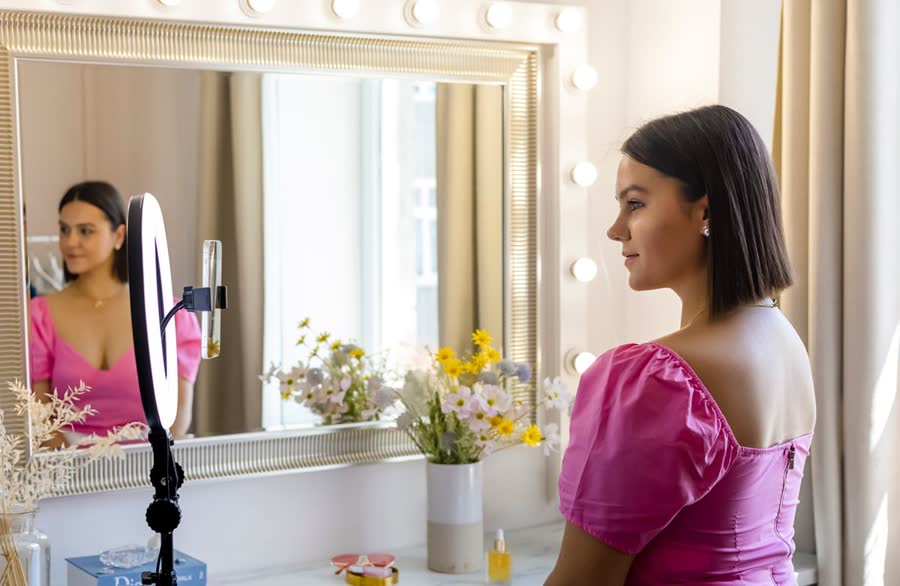
Quality matters a lot, too. Good lighting and clear contrast make your Reel stand out in the feed before the viewer even knows what it's about. That's exactly why so many creators film their key shots in a studio: controlled lighting gives a cinematic look that catches the eye in a split second.
A close-up of your face with a clear emotion also works well: surprise, a smile, a frown. People instinctively stop on faces, especially when they're looking straight into the lens. Looking into the camera in the first second creates the feeling of a direct conversation.
Think of your first frame as a cover, too. If someone sees it in your profile grid or in a preview, it should invite a click on its own.
05TikTok and Instagram hooks: text and sound
On-screen text is your safety net in case the viewer's phone is on mute. It should be short – ideally just a few words – large and easy to read against the image. Place it in a safe zone so it isn't covered by interface elements such as the caption or the buttons on the right.
If you're talking to camera, your first sentence should get straight to the point. Instead of "Hi, today I'd like to tell you about…", say straight away what the viewer will gain. You can move greetings and introductions to the end, or drop them altogether.
Trending sounds can help, but they won't replace content. It's better to match the music to the mood and rhythm of your edit, and sync your cuts to the beats of the track. That kind of consistency makes the video feel dynamic from the very first moment.
06Audience retention: test, analyse, improve
Even the best plan needs testing in practice. In your Reels insights you'll find how many people watched the video and the average watch time. Compare Reels on similar topics but with different openings. After a few weeks you'll see which types of hook suit your audience best.
A simple approach is to film several versions of the opening for the same content. In one studio session you can record three different openings, then post them at intervals or use them in different formats. It saves time and gives you reliable data to compare.
Log your results in a simple table: date, topic, hook type, average watch time and number of saves. A log like this will quickly reveal recurring patterns you'd miss by looking at your insights one by one.
Don't be discouraged if a Reel doesn't perform. Reach depends on many factors outside your control, and a single result tells you very little. What counts is the overall direction and the lessons you draw over a longer period.
07The most common mistakes that ruin the first second
Finally, here are the pitfalls we see most often when editing our clients' footage. Most of them are easy to fix once you know what to look out for.
- A long intro with a logo or title card.
- The first few seconds spent getting into position in the frame.
- Text that's too small or too long to read at a glance.
- A promise in the hook that the video doesn't deliver.
- Poor image quality that makes the Reel disappear in the feed.
Checklist to save
Tick off the points. Your progress is saved in this browser.
Frequently asked questions
How long should a hook be?
The first second matters most, but the whole hook can last up to about three seconds. What's important is that something happens from the very first frame and the viewer immediately knows what to expect.
Does a hook always have to be spoken?
No. Many effective Reels open with just visuals and text. A spoken hook works well for educational content, while a visual one suits fashion, beauty and travel.
Can I use the same hook several times?
You can repeat a formula that works, but change its wording and visuals. Viewers quickly notice copied openings, so rotate between several types.
Hollyfuns Studio · Łódź
Do it with the Hollyfuns crew
Want to film several hook variations in one session and receive ready-edited Reels? Email hollyfuns@gmail.com and we'll plan a shoot at our studio in Łódź.
Series: 12 tips for influencers
Keep reading
 01
01Strategy and content · 5 min read
How to Choose Your Niche: An Influencer's One Sentence About Herself
How to choose your niche as an influencer: find what you could talk about for years, who's listening, and sum it up in one memorable Instagram bio line.
Read the guide 03
03Strategy and content · 5 min read
One Influencer Photoshoot – Content for a Whole Month
One influencer photoshoot can give you content for a whole month. See how to plan four weeks of posts, outfits, shots and Reels in a single day in the studio.
Read the guide 04
04Strategy and content · 5 min read
Consistency Over Perfection: How Often to Post on Instagram
How often should you post on Instagram to grow without burning out? A content calendar, a steady rhythm and batching – a practical plan from Hollyfuns Studio.
Read the guide